


California Capital Gains Tax works just like income tax — the state treats profits from selling stocks, bonds, real estate, or other assets as ordinary income.
Unlike the federal government, which separates short-term and long-term capital gains, California makes no distinction.
Whether you held an asset for 10 days or 10 years, your profit is taxed using the state’s progressive income tax brackets, with rates reaching as high as 13.3%.
That means a big gain could easily bump you into a higher tax bracket and significantly increase the amount you owe.
In this guide, I’ll break down:
- California’s 2026 capital gains tax rates (with real-world examples)
- How federal capital gains tax works (and why timing matters)
- Real estate capital gains rules in California — including Prop 19 implications
- Smart strategies to legally reduce your tax bill
- Common mistakes California residents make with capital gains
By the end, you’ll know exactly how California Capital Gains Tax is calculated, what the combined federal and state tax rate looks like at your income level, and what you can do to keep more of your money.
Key Takeaways
-
California taxes capital gains as ordinary income, with no difference between short-term and long-term holdings.
-
Large gains can push you into higher state tax brackets, increasing how much you owe.
-
Strategies like tax-loss harvesting, installment sales, and charitable giving can help reduce your overall capital gains tax burden.
How Much Is Capital Gains Tax in California?
California’s state capital gains tax treats gains the same way it treats wages: as regular income taxed under progressive income tax brackets.
This means any profit from selling stocks, bonds, real estate, or other assets is taxed according to the state’s ordinary income tax rates.
There is no distinction between short-term and long-term capital gains tax rates for 2026 at the state level. Whether you held the asset for one week or 15 years, your gain is taxed as part of your taxable income under the state’s progressive system.
If your capital gain is significant, it can move you into a higher tax bracket, which affects how much you’ll ultimately owe on your tax returns.
California capital gains tax rates range from 1% to 13.3% based on income for single filers, as shown in this simplified 2026 bracket list:
- 1% rate – Taxable income up to $11,079
- 2% rate – $11,080 – $26,264
- 4% rate – $26,265 – $41,496
- 6% rate – $41,497 – $57,516
- 8% rate – $57,517 – $73,783
- 9.3% rate – $73,784 – $377,778
- 10.3% rate – $377,779 – $453,442
- 11.3% rate – $453,443 – $757,704
- 12.3% rate – $757,705 – $1,000,000
- 13.3% rate (includes 1% Mental Health Services Tax) – Over $1,000,000
Federal Capital Gains Tax Rates for 2026
Unlike California, the federal government taxes capital gains differently depending on how long you owned the investment before selling it.
For 2026, the key distinction is between short-term and long-term capital gains. Short-term gains are typically taxed at ordinary income tax rates, while long-term gains receive preferential tax treatment, with rates of 0%, 15%, or 20%, depending on your taxable income.
This difference can make timing an important part of your tax planning strategy when selling investments.
2026 Short-Term Capital Gains
If you hold an asset for a year or shorter, your gain is taxed as regular income.
These profits are subject to the same income tax rates and can push you into a higher tax bracket, especially if the gain is significant.
Short-term capital gains can be taxed at rates ranging from 10% to 37%, depending on your total income.
2026 Long-Term Capital Gains
If you hold the asset for longer than a year, your gain is typically taxed at a reduced rate.
These federal capital gains tax rates for 2026 vary by income and filing status:
- 0% rate
- Single: $0 – $48,601
- Married filing jointly: $0 – $97,202
- Married filing separately: $0 – $48,601
- Head of household: $0 – $65,100
- 15% rate
- Single: $48,602 – $535,100
- Married filing jointly: $97,203 – $608,350
- Married filing separately: $48,602 – $304,175
- Head of household: $65,101 – $572,350
- 20% rate
- Single: $535,101 and above
- Married filing jointly: $608,351 and above
- Married filing separately: $304,176 and above
- Head of household: $572,351 and above
👉 Note: In addition, higher earners may face the net investment income tax (NIIT)—an extra 3.8% federal surcharge that applies to capital gains and other passive income if your modified adjusted gross income (MAGI) exceeds certain thresholds. Additionally, long-term gains on certain tangible assets like art, rare coins, or precious metals may face a higher maximum tax rate of 28% rather than the usual capital gains rates.
Combined Federal + California Capital Gains Tax Rates
Understanding your California rate or your federal rate in isolation doesn’t tell you what you’ll actually owe.
What matters is the combined effective rate—the total percentage of your capital gain that goes to taxes.
The table below shows estimated combined tax rates for a single filer selling a long-term capital asset in California at various income levels.
These figures include the federal long-term capital gains rate, the California state income tax rate, and the Net Investment Income Tax (NIIT), where applicable.
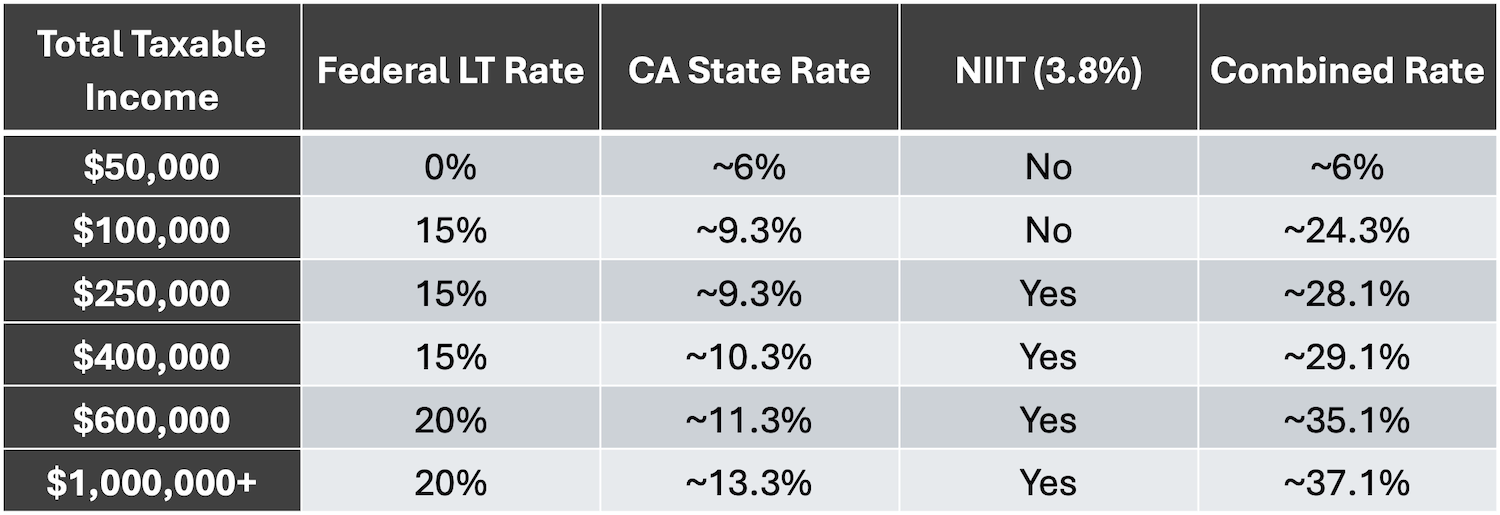
These are simplified estimates for illustration purposes. Your actual rate depends on your complete tax situation, filing status, deductions, and the interaction between your ordinary income and your capital gain.
The California rates shown reflect the marginal bracket your gain falls into, not your effective rate on all income.
As the table shows, a high-income California resident selling a long-term investment could lose more than a third of the gain to taxes.
For short-term gains (held one year or less), the combined rate can exceed 50% at the highest income levels, since both federal and state tax the gain as ordinary income.
This is why timing, tax-loss harvesting, and coordination with lower-income years are so critical for California investors, and why the strategies outlined later in this guide can save tens or even hundreds of thousands of dollars.
Capital Gains Tax on Real Estate in California
Selling real estate in California can lead to unique considerations regarding these gains.
The state’s treatment of home sales and investment properties plays a major role in how much tax you’ll owe.
Additionally, homeowners might wonder how federal rules, such as exclusions for a primary residence, apply at the state level.
This section will look at several areas that often spark questions regarding these topics:
Exclusions for primary residences: Federal guidelines allow you to exclude up to $250,000 of capital gains on the sale of a qualifying primary residence if you file singly, and up to $500,000 if you file a joint tax return. California generally aligns with this approach. However, if your gain exceeds these amounts, the state taxes that extra portion as ordinary income.
Rental property sales and depreciation recapture: When you sell rental property, you’ll owe capital gains tax not only on the property’s appreciation but also on the depreciation you claimed during ownership. At the federal level, this depreciation recapture is taxed separately at your ordinary income tax rate, capped at a maximum of 25%. California, however, does not apply a distinct recapture rate. Instead, the entire gain—including the depreciation portion—is added to your ordinary income and taxed according to your state income bracket.
Inherited real estate and step-up in basis: If you inherit property, the basis is “stepped up” to fair market value at the time of inheritance. California follows federal guidelines in this regard, which can reduce or eliminate the gains if you decide to sell soon afterward. Still, if the property appreciates further after the date of inheritance, you’ll owe tax on that portion of the profit.
1031 exchanges: Real estate investors may be able to defer capital gains taxes by selling one investment property and purchasing another “like-kind” property under Section 1031. To qualify, taxpayers must follow strict rules, including identifying potential replacement properties within 45 days of the sale.
When done correctly, a 1031 exchange can defer taxes at both the federal and California state level. However, California requires taxpayers to track the deferred gain, even if the replacement property is located outside the state. California also generally requires 3.33% withholding when nonresidents sell California real estate. And if an out-of-state replacement property is later sold in a taxable transaction, California may tax the originally deferred gain through its clawback provision.
How to Calculate Capital Gains in California
Determining your gains involves examining costs, improvements, and various adjustments that can increase or decrease your final profit.
The process typically starts with federal calculations and flows through to California’s tax return.
It helps to have solid documentation—especially when assets have been held for an extended time or in cases where improvements have increased their value:
Cost basis and record keeping
Your cost basis typically starts with the purchase price. If you bought a property or set of shares, that initial figure is your baseline. For property, any improvements that add to the property’s value (such as a home remodel) increase your basis. If you have sold or upgraded part of an asset, thorough records will help confirm the correct amount.
Adjustments to basis
Various expenses, including realtor commissions, closing fees, or renovation costs, can boost your basis, which reduces the ultimate gain. It’s wise to keep receipts and documentation for these transactions because forgetting them can lead to paying tax on more profit than you truly earned.
Depreciation recapture implications
For rental or business property, you might have taken depreciation deductions over time. That amount comes back into play at the point of sale, increasing the reported gain. At the federal level, recaptured depreciation may be taxed at an increased rate, capped at 25%. The amount is also included in your California return, where it is taxed as ordinary income.
Federal calculation followed by state taxation
Once the total gain is determined under federal rules, California treats the profit differently. While federal tax rules give preferential treatment to long-term investments, California does not distinguish between holding periods. Instead, the entire amount is taxed as ordinary income under the state’s progressive tax rates for long and short holdings alike.
Strategies to Reduce Capital Gains Tax in California
Selling a property or investment and then handing over a significant portion of your profit is never ideal.
Fortunately, there are tactics that could lessen how much you owe.
Some of these options apply primarily at the federal level but can still influence your financial decisions—especially since California taxes capital gains as ordinary income.
While the state won’t cut you a break on the rate, reducing your taxable gains can still lower what you owe overall.
Here are some strategies you have at your disposal:
Tax-loss harvesting
If you own investments that are worth less than what you paid for them, selling those positions at a loss may help offset capital gains realized during the year.
After selling, you generally cannot buy the same or a substantially identical security shortly before or after the sale without triggering the wash-sale rule. However, you may be able to reinvest the proceeds into a different investment to maintain market exposure.
If your capital losses exceed your capital gains, California generally allows up to $3,000 of excess losses to offset ordinary income. California does not allow capital loss carrybacks. Used thoughtfully, tax-loss harvesting can help reduce your taxable gains and soften the impact of California capital gains taxes.
Holding period
Many investors try to hold investments for more than one year so their gains qualify for lower long-term federal capital gains tax rates. California does not provide a lower tax rate for long-term capital gains. However, the timing of a sale can still affect your total tax bill.
Selling after the one-year mark may reduce your federal tax liability, while delaying a sale until a lower-income year may help make the overall tax impact more manageable. For this reason, your holding period and income level should both be considered before realizing a large capital gain.
Installment sales strategy
Sometimes, sellers choose to spread the proceeds of a sale over multiple years, so the total profit doesn’t land in a single return. If you have a buyer willing to pay in installments, you can tackle your obligations more gradually. This method prevents you from receiving a lump sum that might otherwise push you into a higher tax bracket immediately.
Charitable giving of appreciated assets
Donating appreciated assets—like shares of stock—to a qualified organization may help you sidestep a tax hit on the built-in gain. You typically receive a deduction for the full market value, thereby avoiding the recognition of gain that would occur if you sold first. While this is a federal concept, it indirectly affects what appears on your California forms, as the gain is never reported.
Gifting to lower-income family members
In certain instances, families may gift assets to relatives in a lower tax bracket to reduce the total amount owed across the family as a whole. If the recipient sells later, their rate could be lower. This practice must be approached carefully because transferring valuable property does have potential impacts—particularly if the family member also resides in California.
Using Donor-Advised Funds or Charitable Trusts
High-net-worth investors may consider donor-advised funds or certain charitable trusts to donate appreciated assets while helping manage capital gains tax exposure.
With a donor-advised fund, you can generally contribute appreciated stock or other property, potentially receive a charitable deduction in the year of the contribution, and recommend grants to charities over time. Because the asset is donated rather than sold, this strategy may help avoid immediate capital gains recognition.
Charitable trusts can serve a similar purpose, but they are more complex and typically require careful coordination with tax and legal professionals.
When used thoughtfully, these strategies can help reduce your overall tax bill, manage capital gains liability, and support the charitable causes that matter to you.
Coordinating with retirement timelines
Your overall earnings may drop once you scale back on work. If you wait until a year when you expect less income, your sale could come with fewer overall taxes. This is especially relevant if you plan to take bigger withdrawals from retirement accounts in the future. Timing large transactions during low-income years may help limit the portion of your gain taxed at higher rates.
Additional Exemptions and Special Situations
Certain rules can affect how California taxes your investment gains. For example, federal law under Section 1202 may allow some investors to exclude part or all of the gain from selling Qualified Small Business Stock (QSBS). However, California does not conform to this federal exclusion. As a result, a gain that is excluded for federal tax purposes may still be taxable by California.
Tax-advantaged accounts, such as IRAs and 401(k)s, are also treated differently. These accounts generally allow investment gains to grow tax-deferred until funds are withdrawn. However, when retirement withdrawals begin, the distribution is typically taxed as ordinary income, not as capital gains. This distinction matters for investment management and long-term tax planning.
Taking a large distribution in a single year may increase your taxable income, push you into a higher tax bracket, and result in a larger overall tax bill.
Capital Gains Tax in California FAQs
Many people have common follow-up questions once they realize how California treats profits on the sale of property or investments. Below are a few that frequently arise.
1. Do I owe capital gains tax if I sell my California home?
It depends on the size of your gain. If the home qualifies as your primary residence and you’ve lived there for at least two of the last five years, you can exclude up to $250,000 (single) or $500,000 (married filing jointly) from taxes. Any gain above those thresholds is taxed as ordinary income by California.
2. Does California tax out-of-state capital gains?
Yes. California taxes its residents on all income, regardless of where it was earned, including gains from out-of-state investments and property. If you are a California resident, when you sell an appreciated asset — even one located in another state — the gain is taxable by California.
3. What happens if I move out of California before selling an appreciated asset?
For real property located in California, you’ll still owe California tax on the gain regardless of where you live when you sell. For intangible assets like stocks, bonds, and cryptocurrency, establishing genuine residency in another state before the sale generally means California cannot tax the gain, but the Franchise Tax Board may audit your residency change if a large gain is involved.
4. How are capital gains treated for inherited property in California?
Inherited property receives a stepped-up basis to its fair market value at the date of the previous owner’s death, following federal rules. This means if you sell shortly after inheriting, the taxable gain may be small or zero. Only appreciation that occurs after the inheritance date is subject to California capital gains tax.
5. Can capital gains push me into a higher California tax bracket?
Yes — this is one of the most common surprises for California taxpayers. Because the state taxes capital gains as ordinary income, a large gain is added on top of your salary, retirement income, and other earnings. This combined total determines your marginal tax bracket, which means a single large sale could push you from a 9.3% bracket into the 11.3% or even 13.3% bracket.
Get Help Managing California Capital Gains Taxes
California’s tax treatment of capital gains catches many investors off guard. Unlike the federal government, California does not distinguish between short-term and long-term capital gains. Instead, gains are generally taxed as ordinary income, with rates that can reach as high as 13.3%, including the additional 1% surcharge on income over $1 million.
Whether you are preparing to sell a rental property, reduce a concentrated stock position, or manage the tax impact of business interests, understanding how timing, income, and asset type interact is critical. Federal rules, such as the 3.8% Net Investment Income Tax, depreciation recapture, bracket stacking, and California’s 1031 exchange clawback rules, can all affect your final tax bill.
A proactive plan can help reduce the impact. Strategies such as tax-loss harvesting, installment sales, charitable giving, and coordinating large gains with lower-income retirement years may help you keep more of your gains working for you. These decisions should also be coordinated with your broader retirement income plan, investment strategy, estate plan, and CPA.
At Define Financial, our advisory team specializes in tax-smart retirement planning for California residents age 50 and older. We can help you evaluate your full tax picture, model different sale-timing scenarios, and coordinate with your CPA or estate planning attorney when needed.
If you are planning to sell an appreciated asset or want to better understand how California capital gains taxes fit into your retirement plan, schedule a complimentary Retirement Strategy Session with our team today.